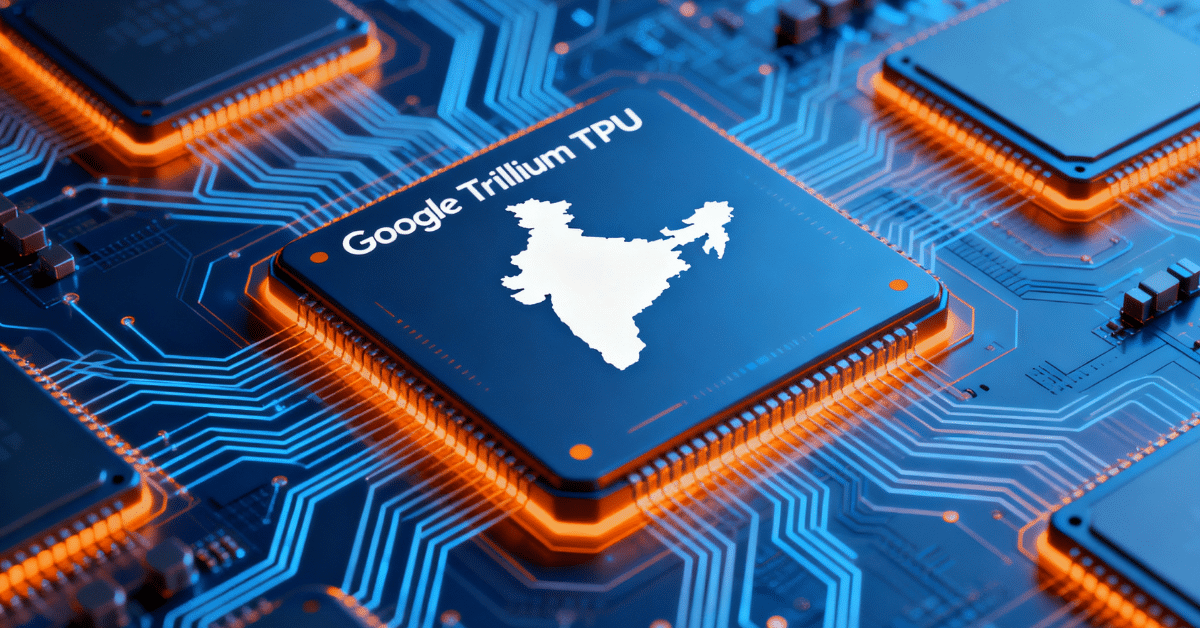
Google Trillium TPU India AI Growth takes a major leap forward as the tech giant expands local AI hardware capacity powered by its advanced Tensor Processing Units, addressing critical data residency and sovereignty requirements for Indian businesses. Google Cloud and Google DeepMind announced on November 11, 2025, a strategic collaboration with IIT Madras to launch Indic Arena, while simultaneously deploying Trillium TPUs to support the country’s growing AI ecosystem. This infrastructure expansion enables Indian startups, universities, government bodies, and enterprises to train and serve advanced Gemini models locally, marking a pivotal moment for the nation’s technological independence.
Tensor Processing Units India Deployment
Google’s Tensor Processing Units represent purpose-built AI accelerators specifically optimized for diverse training, tuning, and inference workloads that power machine learning applications. The deployment of Trillium TPUs in India comes at a critical juncture as the IndiaAI Mission expands its high-performance computing infrastructure by adding approximately 3,850 processing units, including 1,050 Google Trillium TPUs for the first time. This addition pushes India’s total AI cluster capacity beyond 38,000 units, significantly exceeding the initial target of 10,000 GPUs originally allocated Rs 5,000 crore from the mission’s Rs 10,300 crore budget. The strategic integration of Google Cloud AI accelerators into India’s national AI infrastructure demonstrates the government’s commitment to building indigenous large language model capabilities while providing startups and research institutions with world-class computing resources.
TPU v6 Trillium Specifications Performance
The Trillium chip delivers an impressive 4.7x performance improvement in peak compute performance per chip compared to the previous TPU v5e generation, achieved through expanded matrix multiply units (MXUs) and increased clock speed. Beyond raw computational power, Trillium offers over 4x improvement in training performance and up to 3x increase in inference throughput, making it significantly more capable for handling complex AI workloads. Energy efficiency represents another breakthrough, with Trillium achieving a 67% energy efficiency improvement over TPU v5e—a critical advancement as industry demand for machine learning compute has grown by a factor of 1 million in the last six years. Google doubled both the High Bandwidth Memory (HBM) capacity and bandwidth while also doubling the Interchip Interconnect (ICI) bandwidth, ensuring faster data processing across distributed AI systems. The third-generation SparseCore accelerator specializes in processing ultra-large embeddings common in advanced ranking and recommendation workloads, strategically offloading random and fine-grained access from TensorCores to optimize performance. As tech giants race to dominate AI infrastructure, Nvidia CEO Jensen Huang continues addressing unprecedented Blackwell demand in the competitive AI chip market.
IIT Madras Indic Arena Partnership
The IIT Madras Indic Arena partnership establishes a groundbreaking public platform allowing Indian users to anonymously evaluate and rank AI models on tasks specifically designed for the country’s multilingual landscape. Developed by the AI4Bharat center at IIT Madras, the Indic LLM-Arena operates as a crowd-sourced, human-in-the-loop leaderboard that benchmarks large language models across three critical pillars affecting the Indian experience: language, context, and safety. Google Cloud is providing cloud credits to power this community-driven resource, creating a transparent standard for measuring how AI performs across India’s diverse linguistic spectrum. Professor Mitesh Khapra, associate professor at IIT Madras, emphasized the mission to “build AI for India’s specific needs,” noting that a neutral, standardized benchmark is critical for understanding model performance across the nation’s many languages. This collaborative approach ensures that AI model training for Indian developers incorporates local context and cultural nuances that global benchmarks often overlook.
Data Sovereignty Residency Benefits
India Sovereign AI Infrastructure addresses critical data residency requirements mandated by the Digital Personal Data Protection Act (DPDPA), which requires companies to store Indian users’ personal data within the country’s borders. The localized deployment of Trillium TPUs enables businesses in regulated sectors—particularly finance and healthcare—to maintain compliance while leveraging cutting-edge AI capabilities without transferring sensitive data internationally. Google’s expansion of AI hardware capacity with Trillium TPUs specifically supports organizations needing to train and serve Gemini models in India, ensuring data sovereignty while maintaining performance standards. The DPDPA, enacted on August 11, 2023, and set for full implementation in 2025, represents a comprehensive approach to data protection that international AI companies must navigate to operate effectively in India’s enterprise market. By establishing local infrastructure through partnerships with the IndiaAI Mission compute cluster, Google positions Indian organizations to access advanced AI technology while adhering to stringent regulatory frameworks that protect national data interests. As global technology leaders pursue advanced AI capabilities, Microsoft’s humanist approach to superintelligence offers an alternative vision for responsible AI development.
Practical Access Indian Startups Developers
Indian startups and developers now have multiple pathways to access Trillium TPU infrastructure at competitive pricing starting from $2.70 per chip-hour on-demand in US-East1 region, with significant discounts available through 1-year commitments ($1.89/hour) and 3-year commitments ($1.22/hour). The IndiaAI Mission’s allocation of 1,050 Trillium TPUs provides subsidized or grant-based access for qualified startups, researchers, and academic institutions working on indigenous AI solutions. Google also maintains the TPU Research Cloud (TRC) program, offering researchers, students, and entrepreneurs free access to large TPU clusters in exchange for sharing their work through peer-reviewed publications, open source code, or other media. Google Gemini models India availability through Vertex AI on local Trillium infrastructure means developers can build applications without latency concerns or data transfer limitations that plague international deployments. This practical accessibility democratizes AI development, enabling smaller organizations and research teams to experiment with large language models and advanced machine learning workloads previously limited to well-funded enterprises.
Visakhapatnam AI Hub Connection Future
Google’s announcement of a $15 billion investment over five years (2026-2030) to establish an AI Hub in Visakhapatnam, Andhra Pradesh, creates a comprehensive ecosystem connecting infrastructure, data centers, renewable energy, and expanded fiber-optic networks. This gigawatt-scale facility represents Google’s largest investment in India to date and its first AI Hub outside the United States, developed with partners including AdaniConnex and Airtel. Andhra Pradesh Chief Minister N. Chandrababu Naidu highlighted the significance, stating the investment “marks a new chapter in India’s digital transformation journey” and demonstrates shared commitment to innovation and long-term support for businesses and startups in the state. The Visakhapatnam AI Hub will feature purpose-built data center campus infrastructure using the same cutting-edge technology powering Google products like Search, Workspace, and YouTube, creating gigawatt-scale compute capacity to meet demand for digital services across India and globally. Electronics and IT Minister Ashwini Vaishnaw confirmed the new facility will significantly advance the goals of the IndiaAI Mission by providing scalable, locally-controlled computing resources. The strategic integration of Trillium TPU deployment with the upcoming Visakhapatnam hub positions India as a regional AI powerhouse capable of supporting sovereign AI development while serving international markets from Indian soil.
Conclusion
Google’s deployment of Trillium TPUs in India, combined with the IIT Madras Indic Arena partnership and upcoming Visakhapatnam AI Hub, creates a comprehensive ecosystem for sovereign AI development. The 4.7x performance improvement and 67% energy efficiency gains provide Indian developers with world-class computing infrastructure that addresses data residency requirements while maintaining technological competitiveness. As the IndiaAI Mission expands compute capacity beyond 38,000 units, Indian startups, researchers, and enterprises gain unprecedented access to advanced AI infrastructure for building locally-relevant solutions. Developers interested in accessing Trillium TPUs can explore Google Cloud’s pricing options or apply to the TPU Research Cloud program to accelerate their AI innovation journey on Indian soil.