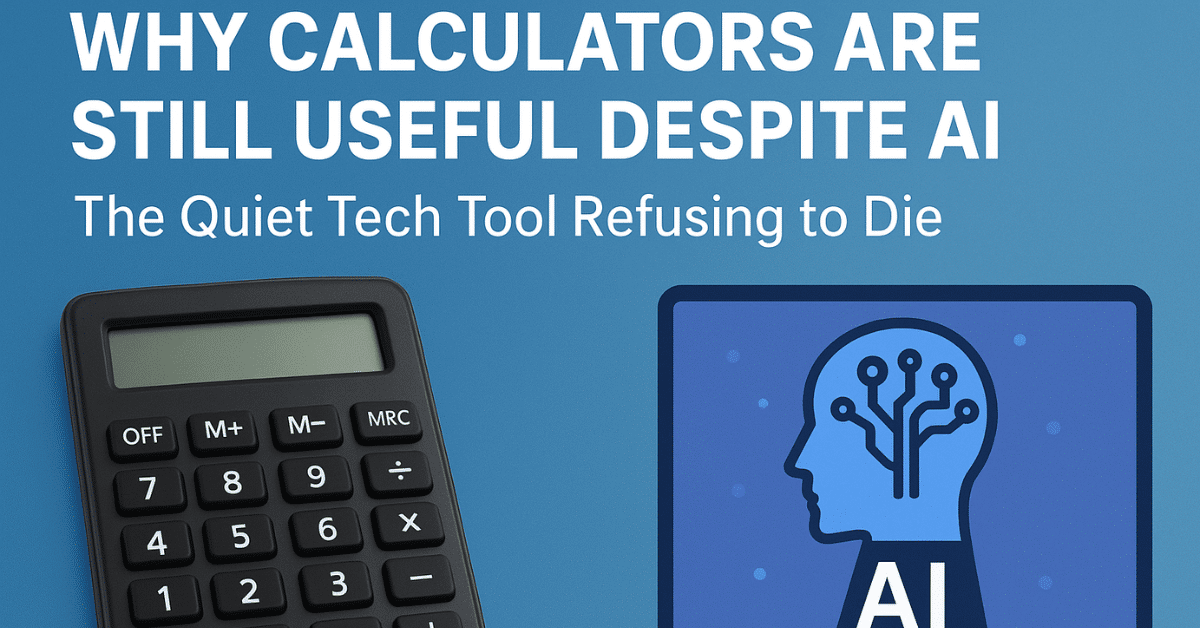
Why calculators are still useful despite AI has become a surprising headline in 2025 as schools, universities, and testing boards reassess the future of education technology in an era dominated by generative AI tools. Across classrooms worldwide, policymakers are now asking whether traditional calculators still matter — and the answer is far more complex than expected.
Why calculators are still useful despite AI: The modern education debate
Even as AI systems solve equations, write essays, and break down complex problems in seconds, traditional calculators remain firmly embedded in global curriculums. Education researchers argue that these devices continue to serve a critical role in teaching problem-solving skills, strengthening mental arithmetic, and preventing excessive cognitive offloading — a growing concern in AI in education environments.
Testing boards across the US, UK, and Asia still require standalone calculators for official assessments, citing academic integrity and consistency. This raises the larger question: If AI can do everything a calculator can — and more — why hasn’t it replaced the calculator?
The rise of generative AI tools isn’t a complete replacement
AI-powered apps like ChatGPT, Google Gemini, and specialized math platforms can now show step-by-step solutions, visualize graphs, analyze errors, and even explain formulas in natural language. This capability has sparked fears that older tools are becoming obsolete.
Yet educators disagree.
Dr. Helena Morris, an education technology researcher at Northeastern University, explains:
“AI tools solve the problem for the student, but calculators help students solve the problem with the tool. That difference matters for learning.”
AI is designed to reduce friction — but learning sometimes requires friction.
Cognitive offloading and the limits of AI dependence
“Cognitive offloading” — relying on digital technology to store or process information for us — has escalated with AI apps that eliminate the need to think through equations. While beneficial for productivity, it can weaken foundational math skills in younger learners.
A 2025 Educause report warns:
“Over-dependence on AI writing tools and math solvers risks eroding essential problem-solving pathways in students.”
This is why many classrooms restrict AI but allow calculators.
Calculators assist the mathematical process without overtaking it. They speed computation but require understanding, structure, and logic from the human side — a balance that AI often overrides.
Security, privacy, and academic integrity
High-stakes exams need secure, offline devices that cannot connect to the internet, store data, or generate full solutions. AI tools fail this requirement entirely.
Standardized testing bodies such as SAT, GCSE, JEE, and IB rely on traditional calculators for three major reasons:
- No connectivity → no cheating
- No stored data → no preloaded answers
- Standardized interface → fairness across test takers
Even the newest smart calculators are restricted to ensure consistent evaluation.
The AI vs calculator debate in classrooms
Educators now face a hybrid reality:
- Calculators build procedural fluency
- AI tools build conceptual understanding
- Classrooms must integrate both strategically
This debate reflects a broader shift in education: how much technology is too much?
Some educators warn that banning AI entirely hinders student progress, while others believe unrestricted AI access makes learning shallow.
A balanced approach is emerging:
teach with calculators, learn with AI — but assess with neither.
Industry insights: AI companies also acknowledge limits
Even AI leaders caution that AI is not an educational cure-all.
In fact, Anthropic’s CEO recently noted rising AI bubble risks, urging the industry to balance innovation with practical limits. You can read more in our analysis here:
👉 AI bubble warnings from Anthropic’s CEO
If AI giants themselves warn against over-reliance, calculators naturally maintain their place.
Why calculators still thrive in a hyper-AI world
Despite the rapid expansion of AI-driven apps in schools, calculators remain resilient because they:
- encourage structured problem-solving skills
- avoid AI hallucinations and errors
- provide exam-safe computation
- protect student privacy
- support incremental learning
- maintain equal access across socioeconomic groups
In many developing countries, a calculator is far more accessible than a smartphone with an AI app. This practical gap alone keeps calculators relevant.
What’s next for education technology?
The future of learning is unlikely to be AI-only or calculator-only. Instead, hybrid learning ecosystems will evolve where:
- AI tutors guide reasoning
- calculators handle computation
- teachers strengthen understanding
- curriculum adapts to avoid over-reliance on any single tool
This aligns with global guidance from organizations like the OECD, whose research on AI in education highlights the need for blended approaches that protect cognitive development.
For deeper insights, you can explore:
Conclusion: Calculators aren’t dying — they’re evolving
While AI reshapes education, traditional calculators remain essential tools that promote balanced learning and discipline. Their simplicity, reliability, and focus on computation rather than explanation make them uniquely valuable in an era dominated by automation.
As the AI vs calculator debate continues, one thing is clear: calculators aren’t disappearing. If anything, they’re becoming a symbol of what education must preserve — the human ability to think before the machine thinks for us.