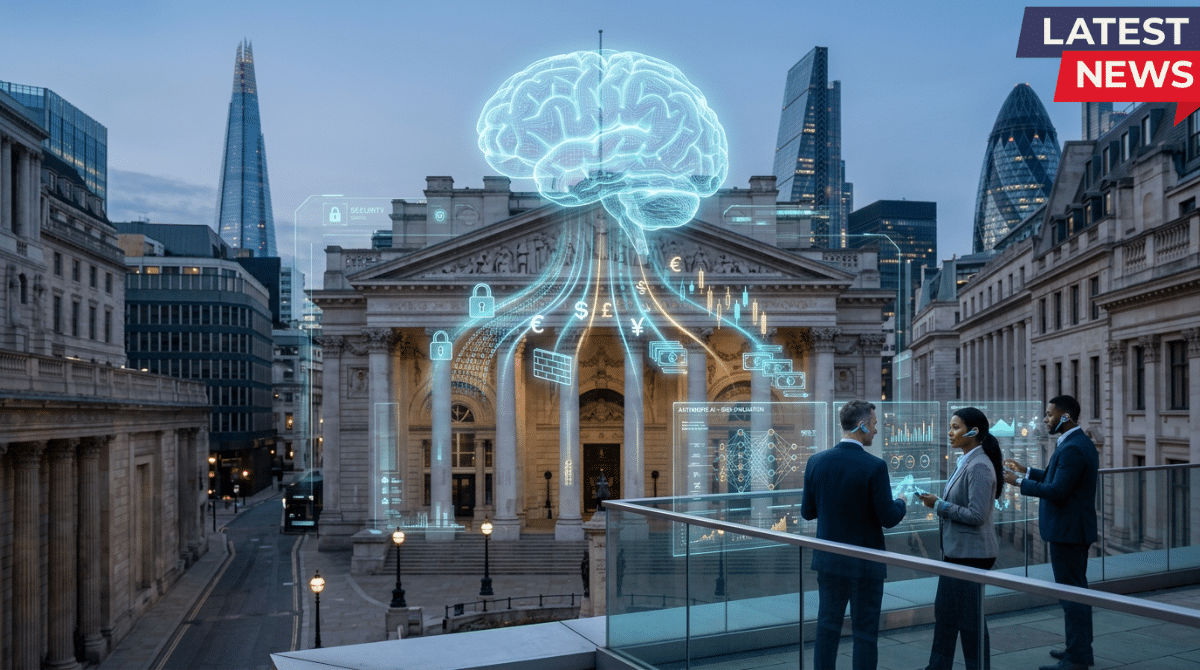
Artificial intelligence adoption on Wall Street has moved beyond experimentation and into routine use inside major US banks. Speaking at a Goldman Sachs financial-services conference in New York on 9 December, senior executives described AI—especially generative AI—not as a future bet, but as an operational upgrade already improving productivity across engineering, operations, and customer service.
Alongside those gains, a more difficult implication is emerging. If banks can consistently do more with the same teams, some roles may no longer be needed at current levels once demand levels off.
How banks say AI is delivering results today
JPMorgan: productivity gains begin to scale
Marianne Lake, chief executive of JPMorgan’s consumer and community banking division, said productivity in areas using AI has increased to about 6%, up from roughly 3% before deployment. Over time, she said, operational roles could see productivity gains of 40% to 50% as AI becomes embedded in everyday workflows.
Those results stem from controlled implementation rather than open-ended experimentation. JPMorgan has focused on secure, internal access to large language models and tightly defined use cases. Its internal “LLM Suite” allows employees to draft and summarise content within a governed environment, with strict controls on data use.
Wells Fargo: higher output before headcount changes
Wells Fargo CEO Charlie Scharf said the bank has not yet reduced headcount because of AI, but noted that teams are “getting a lot more done.” He added that management expects to identify areas requiring fewer people as productivity improvements accumulate.
According to comments reported the same day, Wells Fargo’s internal budgets already point to a smaller workforce by 2026, even before AI’s full impact is accounted for. Scharf also referenced rising severance costs, suggesting preparations for workforce adjustments are under way.
PNC: accelerating an existing trend
PNC CEO Bill Demchak framed AI as an accelerator rather than a new strategic direction. He noted that the bank’s headcount has remained largely flat for nearly a decade despite business growth, driven by automation and branch optimisation. AI, he said, is likely to push that trend further.
Citigroup: gains in software and customer support
Citi’s incoming CFO Gonzalo Luchetti said the bank has recorded a 9% productivity improvement in software development, reflecting broader adoption of AI copilots across large organisations.
He also highlighted improvements in customer service, where AI is strengthening self-service capabilities and providing real-time support to agents when customers do need human assistance.
Goldman Sachs: workflow redesign paired with hiring restraint
Reuters reported that Goldman Sachs’ internal “OneGS 3.0” programme focuses on applying AI to sales processes, client onboarding, and process-heavy functions such as lending workflows, regulatory reporting, and vendor management.
These changes are unfolding alongside job cuts and slower hiring, directly linking workflow redesign to staffing decisions.
Where banks see early productivity gains
Across institutions, the clearest benefits appear in work that is document-heavy, repeatable, and governed by clear rules. Generative AI reduces the time required to search for information, summarise material, draft content, and move tasks through approval chains—especially when paired with structured processes and human oversight.
Early-impact areas include:
- Operations: faster case handling, drafting, and exception resolution
- Software development: code generation, testing, refactoring, and documentation
- Customer service: improved self-service and real-time agent support
- Sales support and onboarding: data extraction, form completion, and client setup
- Regulatory reporting: faster assembly of narratives and evidence under strict review
Governance sets the pace
For banks, the main constraint on AI adoption is not enthusiasm but control. Long-standing regulatory expectations around model risk management—such as SR 11-7 guidance from the Federal Reserve and OCC—extend to AI systems. A 2025 US Government Accountability Office report confirmed that existing governance principles already apply, including testing, validation, and independent oversight.
As a result, banks favour AI systems that can be audited and traced. Prompts and outputs are logged, performance is monitored for drift, and humans retain responsibility for high-impact decisions such as lending, dispute resolution, and official disclosures.
Productivity rises, workforce questions follow
Executives’ comments suggest a two-stage shift. In the first stage, headcount remains stable while output rises as AI tools spread across teams. In the second stage, once gains become predictable, staffing plans begin to adjust through attrition, role redesign, or targeted reductions.
Signals from Wells Fargo around 2026 workforce planning and severance costs suggest some banks are nearing that second phase.
At a broader level, institutions such as the IMF and the World Economic Forum have warned that AI will reshape a large share of jobs, with different mixes of automation and augmentation depending on role and region.
What AI means for Wall Street beyond 2025
Banks that extract the most value from AI are likely to focus on three priorities: redesigning workflows rather than simply adding chat tools, strengthening data foundations, and building governance that enables speed without undermining trust.
The financial stakes are significant. McKinsey estimates generative AI could deliver $200–$340 billion in annual value for the banking sector, largely through productivity gains.
The central question is no longer whether AI works in banking. It is how quickly those gains can be made routine—while maintaining security, auditability, and customer protections—and how institutions manage the workforce changes that follow.