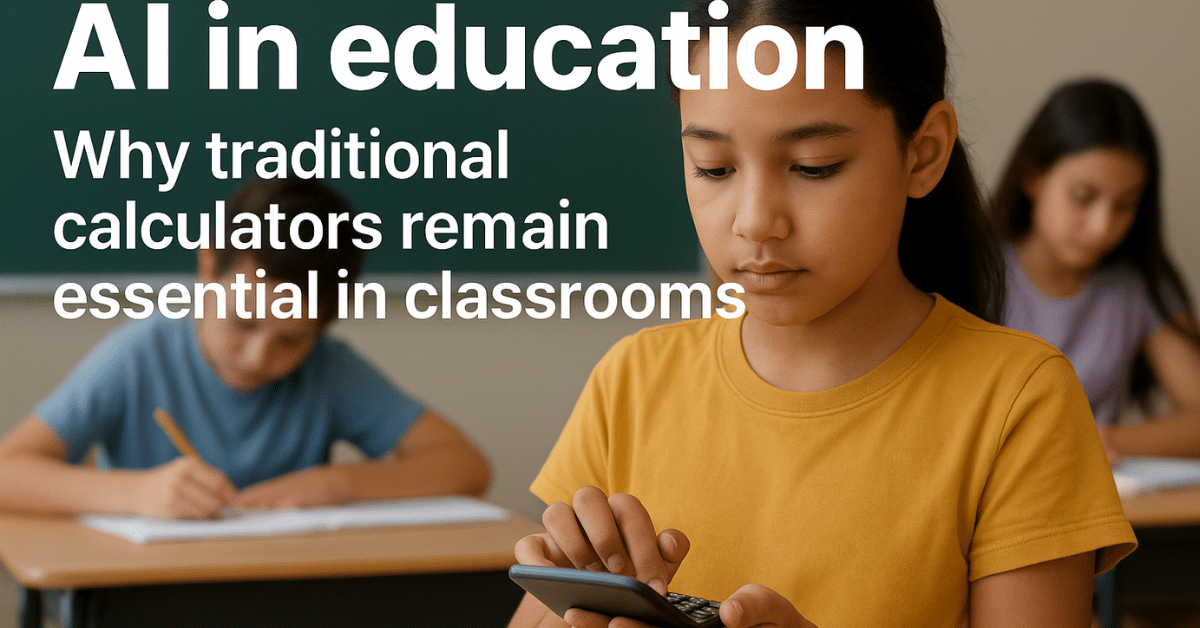
AI in education is reshaping classrooms as schools adopt generative AI tools to personalize learning and automate routine tasks. Yet even as advanced AI systems become more common, traditional calculators continue to play a critical role in strengthening mental arithmetic skills and building foundational problem-solving abilities. Educators increasingly emphasize that calculators help maintain a balanced learning approach, preventing students from over-relying on AI for even the simplest calculations.
How AI in education and calculators can coexist effectively
While generative AI tools can instantly produce answers, explanations, and even full solutions, calculators encourage students to understand the steps behind their work. This combination supports student learning outcomes by ensuring that foundational skills do not fade as technology evolves.
In many schools, calculators remain essential for developing number sense and reinforcing concepts rather than simply providing answers. They reduce cognitive offloading without replacing the mental effort required to analyze mathematical relationships.
Educators caution that students who depend solely on AI tools often struggle during exams, where AI is banned and calculators are the only approved teaching tools in the digital era.
Why mental arithmetic skills still matter in an AI-driven world
A growing body of educational practice demonstrates that mental arithmetic skills enhance reasoning, improve memory, and support long-term mathematical fluency. Calculators act as a complement—not a replacement—to this foundational cognitive workout.
Key benefits include:
- Strengthening numerical intuition
- Improving estimation abilities
- Encouraging active problem-solving
- Training students to validate results independently
When students blend mental arithmetic with calculator use, they not only compute more efficiently but also understand why an answer makes sense.
The role of calculators in reducing cognitive overload
In modern classrooms filled with technology, too many digital tools can overwhelm students. Calculators provide a simple, controlled way to reduce cognitive offloading without removing the challenge of thinking.
They help students:
- Check multi-step problems during practice
- Manage time efficiently during assessments
- Avoid frustration caused by repetitive manual calculations
- Build confidence before tackling complex concepts
By contrast, relying heavily on AI can make students passive recipients of information rather than active learners.
Education technology trends show the need for balance
As AI in classrooms continues expanding, schools face the challenge of balancing innovation with core skill development. Many teachers now integrate AI for explanation and guidance, while reserving calculators for hands-on mathematical tasks.
This blended approach ensures:
- AI helps with concept discovery
- Calculators support procedural fluency
- Mental skills remain central
- Students avoid dependence on automated reasoning
For broader industry insights on automation and digital tools reshaping learning, you can explore our coverage of AI chips layoffs and industry news.
Why calculators remain irreplaceable despite generative AI tools
Traditional calculators continue to serve key functions that AI systems cannot replicate in controlled academic environments:
- Fairness & accessibility: Calculators are universally allowed in standardized exams.
- Predictability: Unlike AI tools, calculators provide consistent, non-interpreted outputs.
- Skill reinforcement: They support effort-based understanding rather than answer-based dependency.
- Classroom control: Teachers can monitor calculator use far more easily than AI tools.
Meanwhile, authoritative studies on math education continue to highlight the importance of moderate calculator integration, as seen in educational research on calculator use.
A future where AI and calculators strengthen each other
The most effective classrooms will not choose between AI or calculators — they will use both wisely. AI in education can personalize lessons and enrich understanding, while calculators ensure students maintain the procedural skills needed for real-world problem-solving.
When these tools are combined, students benefit from:
- Deep conceptual understanding
- Strong computational fluency
- Improved reasoning skills
- Reduced cognitive overload
- Enhanced confidence across math tasks