

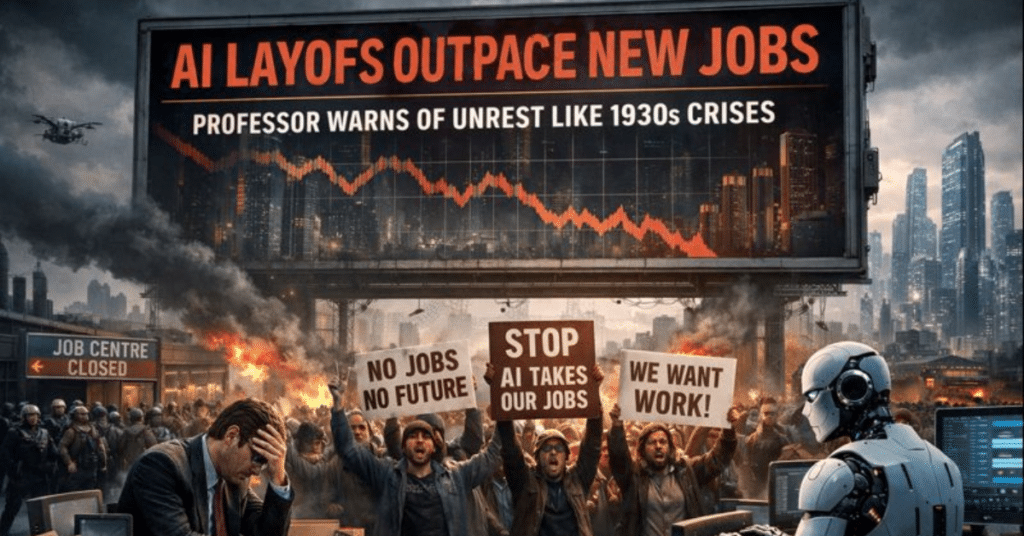
AI layoffs outpace new jobs at a staggering 5:1 ratio, according to Oxford professor Carl Benedikt Frey, raising alarms about social unrest AI could trigger. Drawing from past automation economic shocks, Frey predicts rapid AI job displacement might destabilize labor markets faster than governments can respond. This analysis explores the brewing crisis amid tech layoffs 2025.
Frey, a leading expert on technology’s labor impacts, shared these insights in a recent interview. He points to historical precedents where manufacturing automation history led to widespread unemployment and protests. As Big Tech job cuts accelerate, the warning hits close to home for workers worldwide, from Silicon Valley coders to Indian call center staff.
AI Layoffs Outpace New Jobs: The 5:1 Warning Breakdown
Professor Carl Benedikt Frey bases his forecast on data from previous disruptions. In the 1930s, mechanization in U.S. factories slashed jobs five times faster than new roles emerged, fueling labor riots and policy overhauls. AI unemployment rates could follow suit, with AI automating white-collar tasks at unprecedented speed.
Job creation lag remains the core issue. While AI generates roles in programming, data science, and AI ethics, these demand elite skills most displaced workers lack. Frey estimates that for every five jobs lost to AI job displacement, only one rebounds quickly—leaving millions in limbo.
Recent stats underscore the urgency. Over 77,000 tech positions vanished in 2024 due to AI efficiencies, per layoff trackers. Tech layoffs 2025 projections climb higher, with Google cutting 12,000 roles, Microsoft 10,000, and Amazon signaling more. India’s IT sector faces 50,000 potential cuts as AI business automation accelerates.
Historical Automation Economic Shocks Mirror Today’s Fears
Manufacturing automation history offers stark lessons. During the 1980s, robots in auto plants displaced 200,000 U.S. workers, sparking Rust Belt decline and political shifts. Frey notes similar patterns now: AI tools handle coding, financial analysis, legal research, and even creative work, hitting knowledge economies hardest.
Communities bore the brunt then, with unemployment spiking to 25% in some areas. Protests turned violent—think 1930s Flint sit-down strikes—pressuring governments for retraining programs that arrived too late. Frey warns social unrest AI risks echo this if AI layoffs outpace new jobs without intervention.
India’s textile mills in the 1990s tell a parallel tale. Power looms displaced 1.5 million weavers, creating ghost towns and migration waves. Today’s labor market disruption scales globally, affecting 2.5 billion service workers per McKinsey estimates.
Tech Layoffs 2025: Big Tech Leads the Charge
Big Tech job cuts dominate headlines. Google axed 12,000 roles in Q4 2025 alone, citing AI-driven efficiencies in search and ads. Microsoft followed with 10,000, folding entire teams into automated systems like Copilot. Amazon trimmed warehouse management by 15%, Meta shuttered content moderation units.
Frey highlights how AI amplifies this. Tools like advanced language models now draft reports, debug code, and predict customer churn—roles once deemed safe. AI unemployment rates in tech hit 8% this year, double the national average, with mid-level managers hardest hit.
Workers pivot to AI prompts for survival—check our guide on AI prompts for job search. Upskilling via AI tools offers hope, but only 20% of laid-off workers complete such programs within a year.
Job Creation Lag: Why AI Falls Short on Replacement Roles
New AI jobs sound promising: prompt engineers, AI ethicists, integration specialists, and synthetic data curators. But Frey argues job creation lag dooms most transitions. These roles require 2-5 years of specialized training, excluding mid-career professionals from accounting, marketing, or HR.
Compare to past booms. The internet created 20 million U.S. jobs from 1995-2015, but over decades with broad education access and falling computer costs. AI’s pace leaves no buffer—automation economic shocks hit instantaneously as models improve weekly.
Governments scramble. The EU eyes universal basic income pilots in Finland-style trials; the U.S. boosts community college AI programs with $2B funding. India launches AI education initiatives—explore AI education against displacement to stay ahead. Yet scale remains the problem: retraining 100 million workers needs trillions and decades.
Social Unrest AI: Protests and Political Shifts on Horizon
Social unrest AI looms if trends hold. Frey cites 2019 French yellow vest protests, partly fueled by automation fears among truckers and retail workers. Scale that up: accountants, marketers, journalists—all automated by 2030 per Goldman Sachs.
Vulnerable regions face worst impacts. India’s BPO sector (4 million jobs) and U.S. Midwest service hubs risk 20% unemployment spikes. Frey urges proactive measures like tax incentives for human-AI hybrid roles and “robot taxes” to fund safety nets.
See how UK AI safeguards improving could model global responses. Businesses adopting AI business ethically might blunt edges through reskilling partnerships.
Path Forward: Mitigating Labor Market Disruption
Policymakers must act swiftly. Frey advocates “AI dividends”—taxing automation profits to fund universal retraining vouchers. Corporations could lead with internal reskilling, as IBM’s 50,000-worker program shows early promise.
Individuals aren’t helpless. Mastering AI tools builds resilience against AI job displacement. Professor Carl Benedikt Frey stresses adaptation over resistance: learn to orchestrate AI, not compete against it.
As tech layoffs 2025 unfold, balance innovation with humanity remains critical. Without coordinated action, labor market disruption could redefine society—painfully, echoing history’s hardest lessons.








Comments are closed.