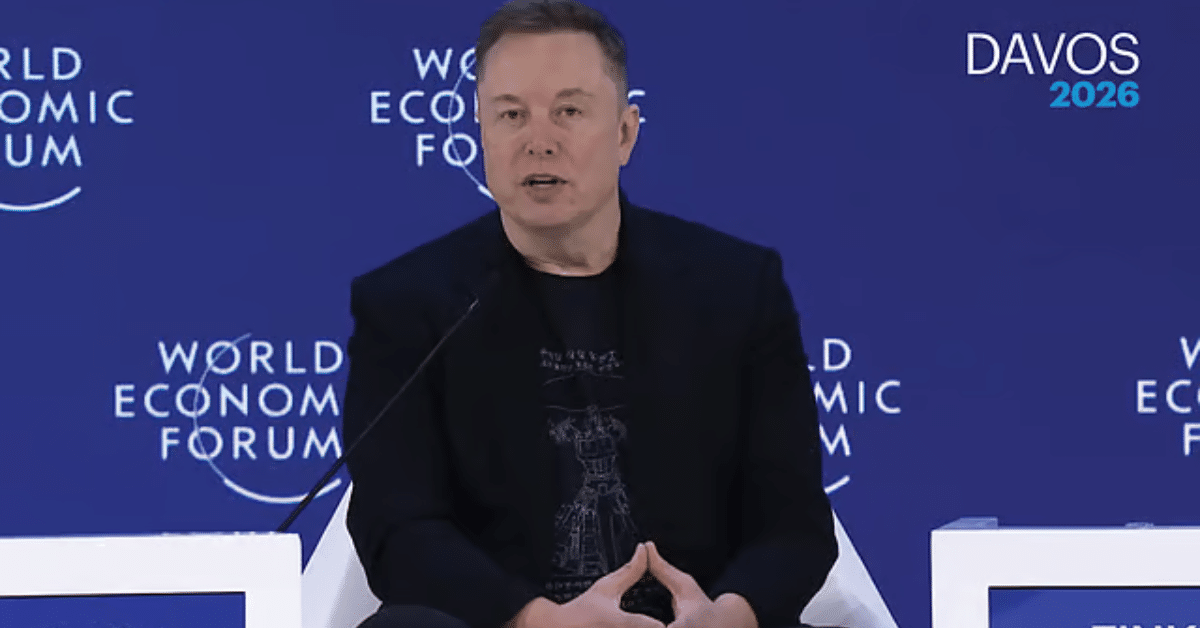
Musk’s remarks came during a high-profile panel, where he addressed accelerating AI superintelligence timelines. He stated, “We will have AI that is smarter than any one human probably by the end of this year,” shifting focus from individual to collective human intelligence benchmarks. This AI 2026 prediction builds on his December 2025 address to xAI employees, warning of a “wild west wildfire race” to AGI within the next 12-24 months.
The Davos World Economic Forum stage amplified the statement, drawing reactions from tech leaders and policymakers. Musk highlighted xAI Grok models as frontrunners, powered by massive compute clusters like the Memphis supercomputer. Unlike vague forecasts, this Elon Musk AI 2026 prediction ties directly to tangible milestones in humanoid robots and multimodal AI.
Key Summary: Elon Musk AI 2026 Prediction
Elon Musk stunned the Davos World Economic Forum (Jan 21, 2026) by predicting artificial general intelligence (AGI) will surpass any single human’s intelligence by year-end 2026, exceeding collective human intelligence by 2027.
**xAI’s Grok models (especially Grok 4) lead this AI superintelligence timeline, powered by 100,000+ Nvidia H100 GPUs in the Memphis supercomputer and validated by Tesla Optimus humanoid robots.
The prediction triggers massive AI business disruption—80% white-collar automation, enterprise AI prompts, and urgent need for global AI governance amid the “wild west” AI industry race.
Musk’s vision culminates in technological singularity by 2030, with xAI’s “truth-seeking” philosophy positioning it ahead of OpenAI and Google DeepMind.
Business leaders must prepare now for AGI-driven transformation across finance, healthcare, and manufacturing sectors
Evolution of Musk’s AI Superintelligence Timeline
Elon Musk has iteratively refined his views on AGI arrival. In 2024, he eyed 2025; by late 2025, timelines compressed to 2026 amid Grok advancements. Recent leaks from xAI reveal internal goals for Grok 4 to match PhD-level expertise across domains by mid-2026.
This acceleration mirrors broader AI industry race dynamics. Competitors like OpenAI and Google DeepMind push boundaries, but Musk critiques their safety focus as slowing progress. His technological singularity vision—AI self-improvement loops by 2030—positions 2026 as the inflection point.
Key factors driving the shift:
- Exponential compute scaling: xAI‘s 100,000+ Nvidia H100 GPUs.
- Data efficiency breakthroughs in Grok training.
- Real-world testing via Tesla‘s Optimus humanoid robots.
xAI Grok Models Role in AGI by 2026
xAI Grok models anchor Musk’s optimism. Grok 3, released late 2025, already rivals top LLMs in reasoning. Musk predicts Grok 4 will achieve AGI thresholds, defined as outperforming humans in economically valuable work.
Internal xAI communications stress “truth-seeking” AI, contrasting “woke” rivals. For AI business and automation, this means enterprise tools automating complex tasks like code generation and strategy planning. Imagine AI prompts directing Grok to optimize supply chains— a reality Musk says arrives in 2026.Explore
**Implications for AI Business and Automation
Musk’s Elon Musk AI 2026 prediction disrupts AI business landscapes. Companies must prepare for AGI-driven automation, where AI handles 80% of white-collar jobs. Sectors like finance, healthcare, and manufacturing face transformation.
Bold opportunities emerge:
- Enterprise AGI platforms from xAI for custom automation.
- Human-AI symbiosis via neural interfaces like Neuralink.
- Global regulation debates, as Musk warns of “extinction risks” without proactive governance.
For content creators on platforms like aicorenews.com, AGI enables hyper-personalized AI education tools. AI tools will generate SEO-optimized articles in seconds, blending human oversight with machine speed.
Skepticism and Counterarguments in AI Industry Race
Not all experts share Musk’s enthusiasm. AI researchers like Yann LeCun argue true AGI requires embodiment and common-sense reasoning, potentially delaying timelines beyond 2026. Critics point to Musk’s history of optimistic forecasts, like full self-driving by 2019.
Yet, evidence mounts: Grok‘s benchmark scores surged 40% in 2025, and Tesla‘s humanoid robots demoed factory tasks autonomously. The AI superintelligence timeline debate fuels investment—xAI raised $6B in 2025 alone.
**Roadmap to Technological Singularity 2030
Musk envisions 2026 AGI enabling superintelligence by 2027, culminating in technological singularity around 2030. This era features AI inventing breakthroughs beyond human comprehension, from curing diseases to interstellar travel.
xAI prioritizes safe scaling, with “alignment” baked into Grok‘s core. For AI education, Musk advocates widespread access to tools like Grok, democratizing intelligence.
What Elon Musk AI 2026 Prediction Means for You
Business leaders should audit workflows for automation readiness. Developers can experiment with xAI Grok models today via APIs. As the AI industry race intensifies, staying informed via aicorenews.com positions you ahead.