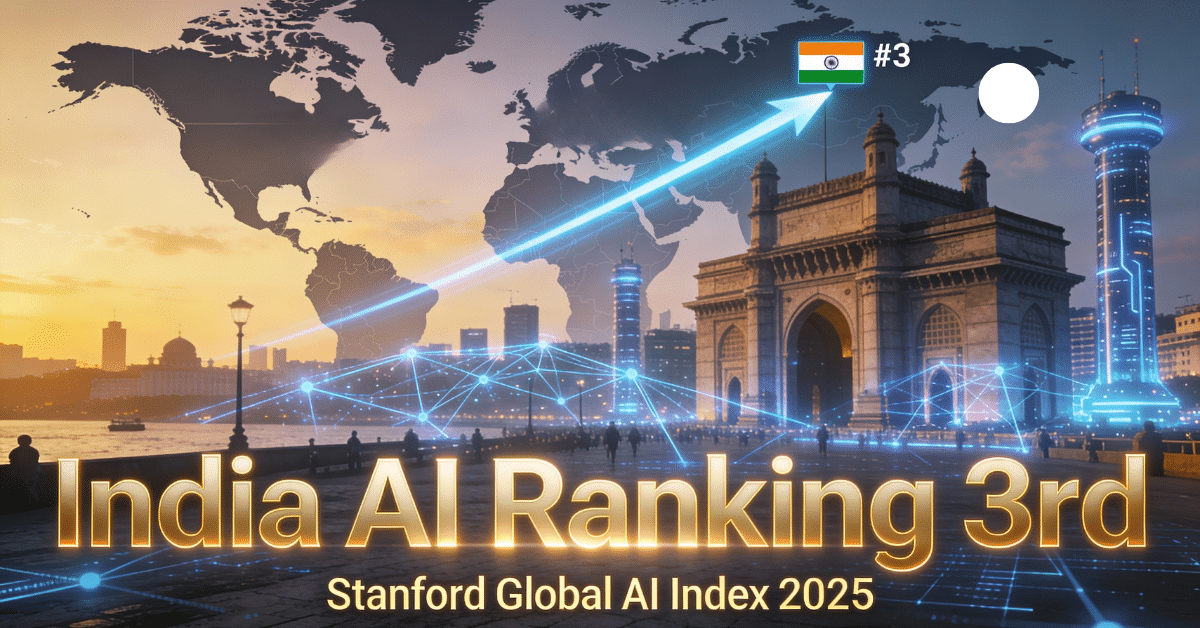
India AI Ranking 3rd has instantly reshaped the global AI conversation, as the country jumps into the top tier of artificial intelligence powers alongside the United States and China. According to the latest Stanford Global AI Vibrancy Tool 2025, India now holds the third spot in a closely watched global AI competitiveness ranking, overtaking several advanced economies and signalling a new phase in its technology ambitions. This dramatic rise highlights India’s growing AI talent, research output, and policy momentum at a time when nations are racing to secure an edge in next‑generation technologies.
Key Highlights
- India climbs to 3rd place in Stanford’s Global AI Vibrancy Tool 2025, behind only the US and China.
- The country overtakes the UK, South Korea, Singapore and Japan in overall AI ecosystem strength.
- India’s AI ecosystem score reflects rapid gains in talent, research, startups and digital infrastructure.
- The ranking reinforces India’s positioning as a strategic AI hub for global tech companies and investors.
- Policymakers are pitching the result as proof that India can be a trusted, large‑scale AI partner in the global South.
Why This Jump Matters Now
This surge in India AI Ranking 3rd comes at a time when AI has moved from a buzzword to the backbone of national competitiveness, economic growth and geopolitical influence. For India, the new ranking is more than a prestige upgrade: it strengthens the country’s bargaining power with global tech firms, boosts confidence among domestic startups, and supports the government’s narrative that India can be a leading, democratic AI powerhouse. Readers can expect deeper context on what drove the jump, which countries India leapfrogged, and what challenges still stand between third place and true AI leadership.
“India has overtaken the United Kingdom, South Korea, Singapore and Japan to become the world’s third‑most dynamic AI ecosystem.”
— Based on Stanford’s Global AI Vibrancy Tool 2025 coverage
How Stanford’s Global AI Vibrancy Tool Ranks Countries
Stanford’s Global AI Vibrancy Tool is part of its broader AI Index and tracks how dozens of countries are performing across indicators such as research papers, AI talent, investment, infrastructure and government policy. The tool is widely followed because it aggregates data from multiple sources and turns it into a single, comparable view of global AI competitiveness ranking, giving governments and companies a benchmark of where they stand.
For readers who want to explore the methodology and country dashboards in depth, Stanford offers a dedicated explainer and interactive views on the Global AI Vibrancy Tool page. This provides additional context on how India compares with other AI powers and where it still needs to catch up.
What Pushed India to 3rd Place
A key driver behind India AI Ranking 3rd is the country’s expanding AI talent and research footprint, fuelled by its large STEM pipeline and strong presence of global tech centres. India has become a major hub for AI development work, with multinationals and cloud players scaling engineering teams and research labs in Bengaluru, Hyderabad and other tech cities.
The ranking also reflects momentum in the India AI startup ecosystem, where new ventures are building tools in sectors like finance, healthcare, education and enterprise productivity. At the same time, government initiatives such as the IndiaAI Mission and broader AI policy frameworks aim to unlock compute infrastructure and shared datasets, which help local companies experiment and scale faster. This shift is also visible in stories like Google’s funding push for India AI centres and coverage of the thin-wrapper AI startup crisis in India, which show both the investment inflows and the pressure on shallow, wrapper-style AI companies.
Global Context: US, China and the Rest
Even with India’s jump, the gap with the AI leaders US and China remains substantial in areas like frontier model training, chip manufacturing and large‑scale AI compute. These two countries dominate high‑end semiconductor supply chains, foundation model development and mega‑scale AI investments, while India’s current strength is more concentrated in applied AI, services and developer talent.
However, India’s move to third place puts pressure on mid‑tier powers such as the UK, South Korea and Singapore to respond, either by boosting funding or by forming deeper partnerships with emerging AI hubs. For investors and big tech, the new ranking reinforces India’s status as a critical market for AI deployment, data‑rich experimentation and long‑term platform growth.
What’s Next for India’s AI Ambitions

India’s new position in the Stanford Global AI Vibrancy Tool gives policymakers and industry leaders a narrative win, but sustaining it will require addressing compute shortages, regulatory clarity and support for genuinely deep tech innovation. The country will also need to balance rapid adoption with AI talent and research in India that focus on safety, inclusion and low‑resource languages to serve its vast and diverse population.
If India can convert this momentum into stable policy, reliable infrastructure and stronger support for home‑grown AI products rather than just services, the label of “third‑most dynamic AI ecosystem” could evolve into a long‑term structural advantage in the global AI race.