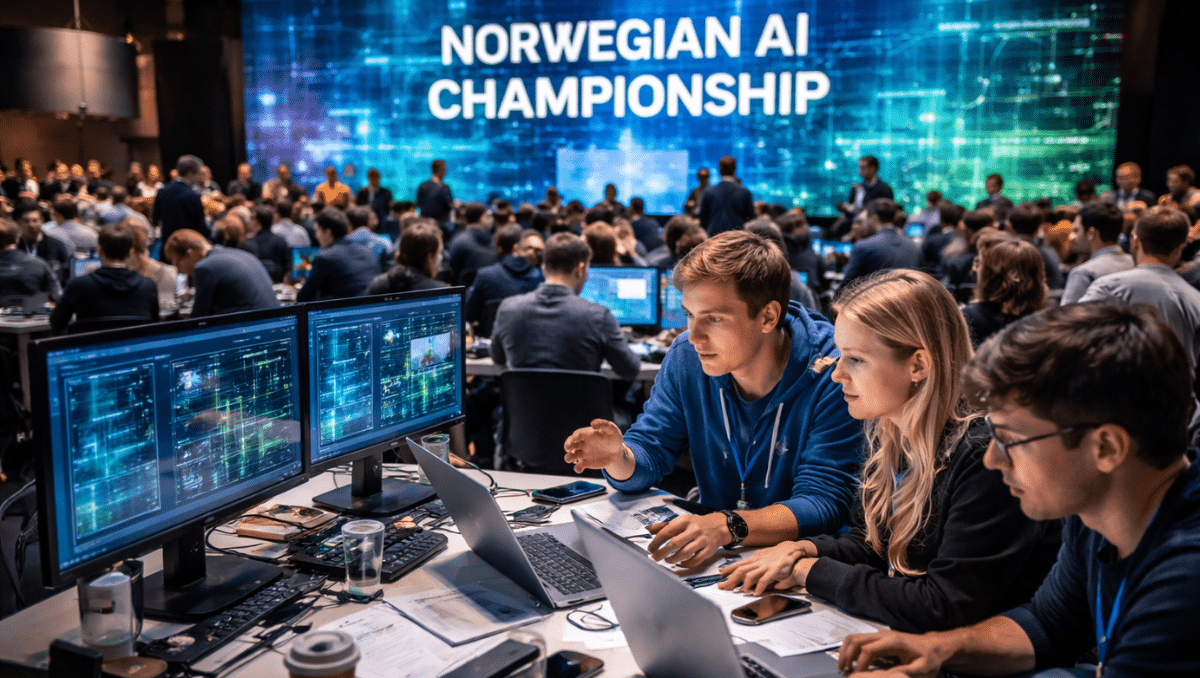
The Norwegian AI Championship applied AI skills shift is redefining how artificial intelligence talent is trained and evaluated. The 2026 edition of the Norwegian AI Championship has emerged as a landmark event, showcasing a clear transition from theory-heavy learning to hands-on, real-world AI problem solving.
With more than 2,000 participants across Norway, the competition highlights a growing demand for practical AI expertise that aligns with industry needs. This shift reflects how companies are now prioritizing execution, adaptability, and real-world problem-solving over traditional academic credentials.
A Nationwide AI Competition Focused on Real-World Challenges
Unlike traditional academic contests, the Norwegian AI Championship is structured around real-world use cases. Participants are required to solve practical problems using modern AI tools and cloud-based environments, simulating actual production scenarios.
Key highlights of the competition include:
- Real-time AI problem solving under pressure
- Use of enterprise-grade AI tools
- Scenario-based challenges reflecting industry needs
From logistics optimization to multi-agent simulations, the competition tests participants on how effectively they can apply AI in realistic situations rather than just theoretical understanding.
Applied AI Skills Take Center Stage
The biggest takeaway from the Norwegian AI Championship applied AI skills shift is the growing importance of applied AI skills over theoretical knowledge.
Participants worked in workflows where:
- Humans defined the problem and strategy
- AI tools assisted in generating solutions
- Continuous iteration improved outcomes
This reflects a new paradigm in AI work environments where collaboration between humans and AI systems is essential. The ability to experiment, adapt, and deploy solutions quickly is now a critical skill.
Enterprise-Level Tools Bridge Education and Industry
A major strength of the competition is its use of real-world infrastructure. Participants gain exposure to tools and environments commonly used in professional AI development.
This includes:
- Cloud-based AI platforms
- Scalable computing systems
- Deployment-focused workflows
Such exposure helps bridge the gap between education and employment, ensuring that participants are industry-ready from day one.
AI Talent Development and Workforce Transformation
The Norwegian AI Championship is also playing a key role in shaping the future AI workforce. By opening participation to students, professionals, and startups, it creates a diverse talent pool and accelerates AI skill development.
Key trends emerging from the event:
- Increased demand for practical AI skills
- Shift toward skill-based hiring
- Growing importance of AI-human collaboration
Organizations are increasingly looking for individuals who can demonstrate real capabilities rather than just academic qualifications.
Experimentation Becomes the New Learning Model
Another major insight from the Norwegian AI Championship applied AI skills shift is the cultural transformation in learning methods.
Traditional learning models focused on:
- Static knowledge
- Exams and theory
- Individual performance
The new AI learning model focuses on:
- Rapid experimentation
- Iterative problem-solving
- Collaborative workflows with AI
This approach better reflects how AI is used in real-world environments, where speed and adaptability are crucial.
Global Implications of the AI Skills Shift
The Norwegian AI Championship is not just a national initiative. It reflects a broader global transformation in AI education and workforce readiness.
Key implications include:
- AI literacy becoming essential across industries
- Hands-on experience replacing theoretical dominance
- Competitions emerging as effective learning platforms
Countries adopting similar approaches may gain a significant advantage in building AI-ready talent pools.
Conclusion
The Norwegian AI Championship applied AI skills shift marks a turning point in how AI skills are developed and assessed. By emphasizing real-world applications, enterprise tools, and human-AI collaboration, the competition sets a new benchmark for AI education.
As industries continue to evolve, the ability to apply AI knowledge in practical scenarios will define the future of work.