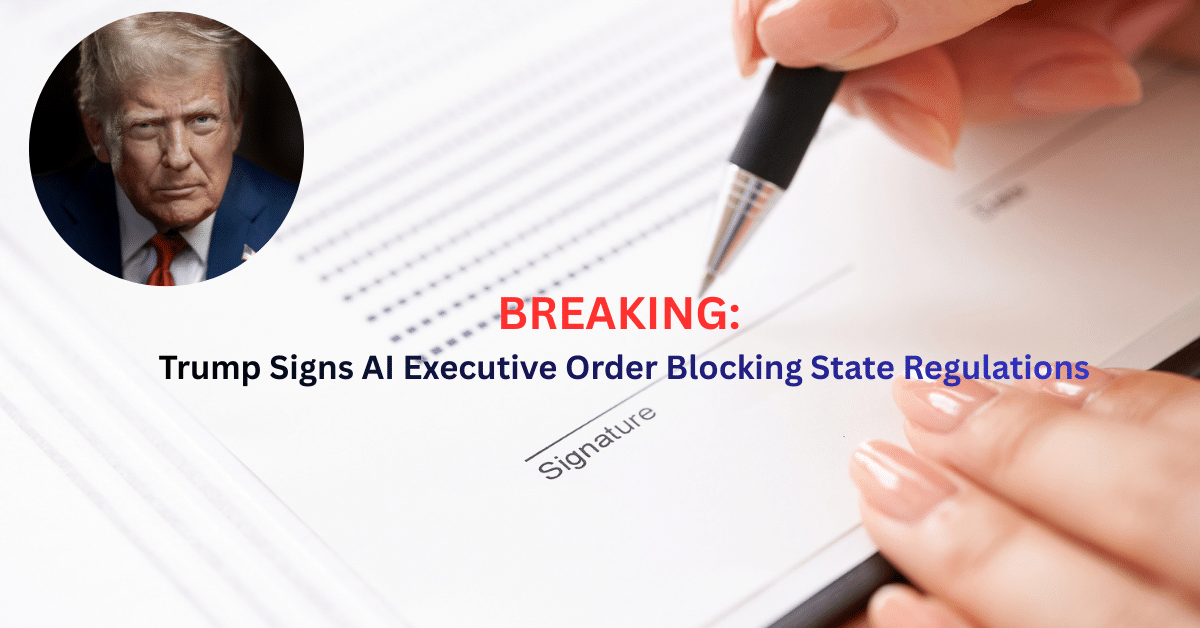
Trump signs AI executive order today, December 11, 2025, handing federal control over artificial intelligence rules and stripping states of their power to enforce local AI regulations. This bold move from the White House aims to end the chaos of conflicting state laws and supercharge AI innovation across America. Signed in a White House ceremony, the order marks a decisive shift toward a national AI framework that prioritizes speed, competitiveness, and a unified approach to governing cutting-edge technology.
Key Highlights
- Blocks states from imposing their own AI regulations, pushing for one national AI framework instead of a patchwork of 50 different rules.
- Launches a DOJ AI litigation task force specifically designed to sue states over conflicting laws and challenge them in federal court.
- Ties federal broadband funding through the BEAD program to compliance, potentially costing non-cooperative states millions in critical infrastructure dollars.
- Targets state rules forcing AI models to change truthful outputs or embed ideological content like mandatory DEI requirements.
- Connects directly to broader U.S. AI strategy, including the Trump China Nvidia chips ban that protects American AI hardware leadership.
- Creates deadlines for federal agencies to act fast, with the task force operational within 30 days and full state reviews completed in 90 days.
Why This Matters Now
America faces a state vs federal AI showdown at a critical moment. Over 40 states have introduced or passed AI regulations in 2025 alone, covering everything from deepfake disclosures to algorithmic bias audits. Tech giants like OpenAI, Google, and Nvidia have warned that this fragmented approach creates massive AI compliance headaches, forcing companies to customize products for each state’s unique rules.
This AI executive order solves that problem by establishing one central source of approval, as President Trump emphasized during the signing. According to the White House fact sheet on national AI framework, “Fragmented state regulations threaten American leadership in artificial intelligence by creating uncertainty and stifling innovation.” With China investing billions in AI and attempting workarounds like the Trump China Nvidia chips ban, the U.S. can’t afford regulatory infighting.
The stakes extend beyond business. A unified federal AI policy could accelerate breakthroughs in healthcare diagnostics, autonomous vehicles, and national security applications. But it also raises tough questions about consumer protections when states lose their traditional authority to safeguard residents.
Core Provisions Explained
Titled Ensuring a National Policy Framework for Artificial Intelligence, this Trump AI executive order packs several powerful mechanisms into one document. First, it directs the Attorney General to immediately stand up an AI litigation task force at the Department of Justice. This specialized unit will identify, investigate, and legally challenge state AI regulations deemed unconstitutional, preempted by federal law, or harmful to innovation.
The task force has a clear focus: laws that require AI developers to alter truthful outputs, disclose proprietary safety testing data, or embed specific ideological viewpoints. White House officials called these requirements “censorship by regulation,” arguing they violate First Amendment protections for speech generated by AI systems.
Second, the Commerce Secretary must conduct a comprehensive 90-day review of all existing state AI laws. Any found to conflict with national priorities will trigger recommendations for enforcement actions, including funding penalties. The broadband funding AI linkage is particularly sharp—states risk losing BEAD program grants worth billions unless they align with the single AI rulebook.
Third, agencies like the FTC and FCC receive marching orders to block states from mandating DEI content or other compelled speech in AI models. The administration views these as deceptive practices that could mislead users about an AI’s capabilities or neutrality.
States Feeling the Heat
While the order doesn’t name specific targets outright, the White House fact sheet points to examples like California’s expansive AI safety mandates and Colorado’s algorithmic discrimination rules. These laws require extensive risk assessments and reporting that federal officials see as overly burdensome.
California, home to Silicon Valley, faces the biggest potential hit. Losing BEAD funds could delay rural broadband expansion while governors fight back in court. Colorado lawmakers argue their bias protections fill a federal void, but the AI litigation task force will test that claim quickly.
Other states like New York, Illinois, and Texas are watching closely. Texas, with its pro-business stance, quietly welcomes the order, while blue states prepare legal defenses emphasizing states’ rights under the 10th Amendment.
Industry Cheers, Critics Push Back
The tech industry erupted in praise. The Chamber of Commerce called it a “game-changer for AI innovation boost,” estimating compliance costs could drop by 70% under a national AI standard. Startups, which lack resources to navigate 50 state regimes, stand to benefit most from this deregulation push.
Consumer advocates and civil rights groups see red flags. “Without state oversight, we’ll see more biased hiring algorithms and unchecked deepfakes influencing elections,” warned one nonprofit leader. Legal scholars predict a wave of lawsuits testing whether federal funding leverage crosses constitutional lines.
Global Context and What’s Next
This order fits neatly into Trump’s comprehensive Trump AI action plan, which emphasizes American supremacy through deregulation and strategic export controls like the Trump China Nvidia chips ban. By clearing domestic hurdles, the U.S. aims to outpace international rivals.
Looking ahead, agencies face intense pressure. The AI litigation task force launches within 30 days, Commerce delivers its report in 90, and a special AI/crypto advisor will draft legislation for Congress to codify the federal AI policy. Court battles could drag on for years, but the message to states is unmistakable: align with Washington or pay the price.
This Trump signs AI executive order moment reshapes America’s tech landscape, betting big on centralized control to fuel the AI innovation engine. Whether it sparks a golden age or regulatory vacuum remains the billion-dollar question.