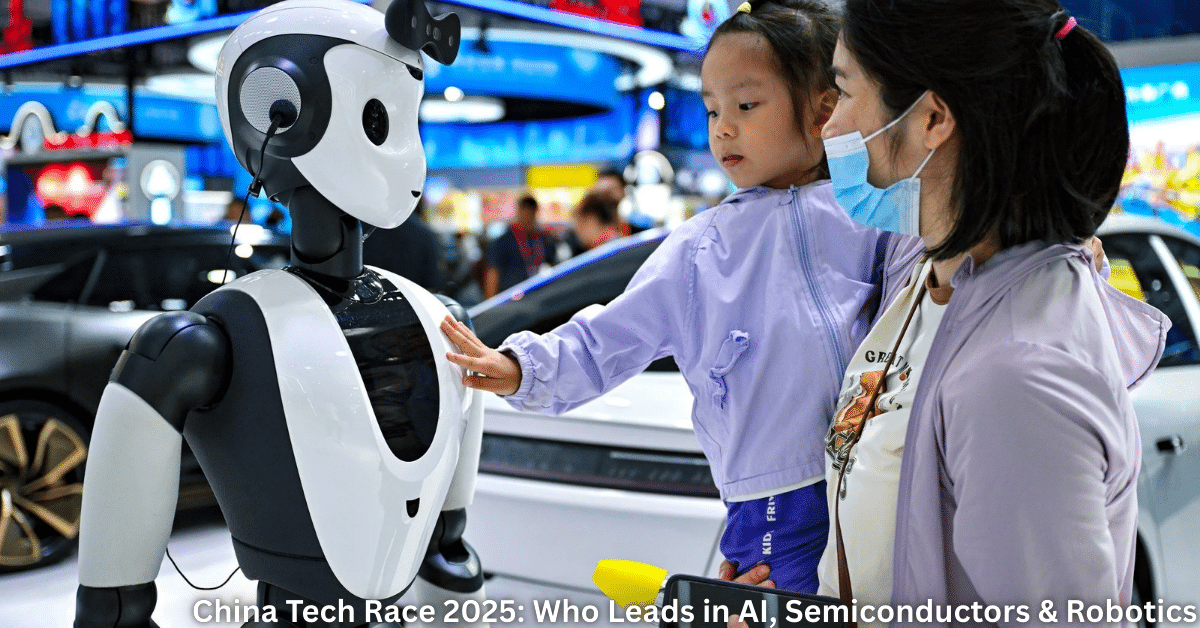
US vs China Tech Race 2025: Who Leads in AI, Semiconductors & Robotics heats up as both nations push hard for global AI leadership. The battle covers advanced models, chip production, and robot factories, shaping the future of tech. This race matters because it affects jobs, prices, and tools you use daily. Businesses face higher costs from tech export controls, while everyday users see faster robots and smarter AI apps. This article breaks down the leaders, key moves, and what comes next in simple terms.
Key Highlights
- US pours $109 billion into AI, leading in top models like GPT-5 and cloud power.
- China installs over 2 million industrial robots, dominating factory automation.
- NVIDIA GPU dominance holds strong, but Huawei AI chips close the gap fast.
- US CHIPS Act funds new factories; China builds massive chip clusters with cheap energy.
- Robotics sees China ahead in real-world use like drone deliveries and uncrewed taxis.
- Both fight over talent and quantum tech, with no clear winner yet.
US vs China Tech Race 2025: AI Supremacy Battle Breakdown
The US vs China Tech Race 2025: Who Leads in AI, Semiconductors & Robotics shows a clear split. America excels in creating the smartest AI brains, while China rolls them out in huge numbers.
US firms release frontier models that set global standards. These power everything from chatbots to drug discovery. China responds with efficient open-source models like DeepSeek-R1, which run on less power and cost less to train.
Global AI leadership hangs in balance as China builds data centers worldwide. US export rules slow high-end chips, but smuggling and homegrown designs keep China moving.
AI Model and Talent Edge
US attracts top brains from everywhere, fueling breakthroughs in frameworks and quantum computing edge. China trains millions in AI, focusing on practical apps.
hyperscalers like ByteDance spend big on compute despite limits. This AI supremacy battle pushes both to innovate faster.
For users, US models mean better free tools; China’s mean cheaper services soon.

Semiconductor Chip War: NVIDIA vs Huawei
Semiconductor chip war defines the hardware fight. US and allies control the best tools for tiny, fast chips.
Semiconductor Industry Association tracks how US leads design, but China invests most in factories. US CHIPS Act gives billions for home plants, cutting Taiwan risks.
NVIDIA’s latest GPUs power AI training worldwide. China uses older nodes smarter, with Huawei AI chips matching H800 levels in tests. Cheap power helps China scale clusters huge.
| Area | US Lead | China Strength |
|---|---|---|
| Advanced Nodes | EUV tools, 2nm chips | 7nm mass production |
| Investment | $50B+ subsidies | Record factory spending |
| Key Players | NVIDIA, TSMC | Huawei, SMIC |
| Vulnerabilities | Supply chains | Export bans |
This table shows why neither achieves full self-reliance yet. Users feel it in GPU prices and AI speed.
Robotics Innovation Race: Factories and Streets
China wins robotics innovation race with real deployments. Over 2 million units work in factories, far ahead of others.
US focuses research; China builds. Drone deliveries, robotaxis, and automated plants run daily. State plans target “chokehold” tech like robotics for scale.
EY-NVIDIA Physical AI Platform Launch shows US pushing “physical AI” for robots that think and move. China already uses it in warehouses.
For businesses, China’s cheap robots cut costs. Users get faster delivery bots.
Factory Automation Leaders
Chinese robot factories churn parts for EVs and phones. US bets on smart software.
CSIS China Tech Analysis notes policy drives China’s speed. US counters with talent and venture cash.
Major 2025 Moves and Future Outlook
2025 saw US tighten tech export controls, pushing China to alternatives. Quantum and 6G emerge as next fronts.
US-Taiwan holds top nodes; China dominates rare earths. No full decoupling – both need each other’s strengths.
Predictions say US keeps model edge, China deployment lead. Watch inference chips and embodied AI.
What This Means for You
In this semiconductor chip war, prices may rise short-term but fall with more factories. AI tools get smarter; robots handle dull jobs.
Stay ahead by learning skills in both ecosystems. Check Latest AI Industry News for updates.
This race boosts innovation for all, but watch supply risks.