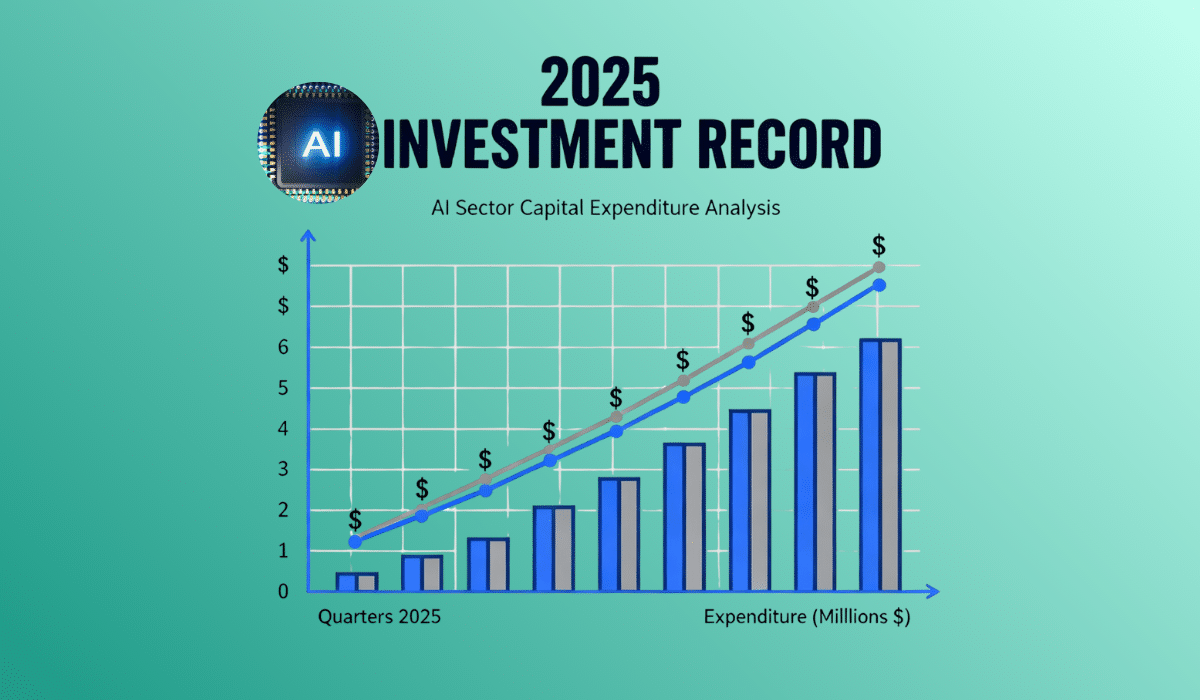
AI drives record US capex spending as American corporations shift their financial priorities dramatically, allocating unprecedented resources toward artificial intelligence infrastructure rather than traditional shareholder returns. S&P 500 companies have announced capital expenditure plans totaling $1.2 trillion in 2025, marking the highest level since data tracking began in 1999.
Historic Shift in Corporate Capital Allocation
Tech companies investment in AI infrastructure has fundamentally transformed how major corporations deploy their capital resources. The largest nine S&P 500 companies account for nearly 30% of total spending, with major hyperscalers including Amazon, Alphabet, Meta, Microsoft, Oracle, and CoreWeave collectively unveiling $400 billion in capital expenditure growth for 2025 alone. This massive reallocation represents a historic pivot in corporate investment strategy, similar to recent major funding rounds in the AI sector.
Goldman Sachs forecast reveals that the investment bank has reduced its prediction for US share buyback growth to just 9%, down from a previous estimate of 12%, as AI innovation spending is expected to continue its aggressive pace through 2026. While S&P 500 companies repurchased nearly $550 billion in shares during the first half of 2025, buyback growth completely flatlined in the second quarter.
Shareholder Returns vs AI Investment Trade-Off
The share buyback reduction trend has been most pronounced among technology leaders traditionally known for returning cash to shareholders. The Magnificent Seven companies, which typically account for 30% of S&P 500 buyback spending, posted 0% year-over-year growth during Q2 2025. Companies reported 24% year-over-year capital expenditure growth in Q2 2025, while gross buybacks declined by 1%.
According to Wells Fargo’s chief equity strategist, the market is rewarding companies based on their artificial intelligence infrastructure growth potential rather than immediate shareholder returns. Even companies with substantial buyback programs like Apple have underperformed peers perceived as AI leaders, while AI-focused firms like Alphabet, Meta, Microsoft, and Oracle have achieved double-digit price returns this year.
Record Investment Levels and Future Projections
Technology investment trends indicate this shift is far from temporary. Goldman Sachs projects hyperscaler capital expenditures will surge to $1.4 trillion between 2025 and 2027, with Microsoft’s spending expected to increase from $76 billion to $376 billion during this period. This aggressive investment pace mirrors the substantial funding that AI companies are receiving, demonstrating widespread confidence in AI’s transformative potential.
The corporate capital allocation strategy reflects a fundamental belief that AI infrastructure represents the next major technological revolution. Despite total shareholder returns hitting a record $1.65 trillion for the 12 months ending June 2025, investors are increasingly prioritizing long-term AI innovation over immediate cash payouts.
Market Response and Investment Community Sentiment
Financial analysts note that tech companies investment decisions are being validated by market performance. Companies demonstrating strong AI capabilities and infrastructure commitment are receiving premium valuations compared to peers focused primarily on returning cash to shareholders. This market behavior reinforces the strategic shift toward AI innovation spending.
Goldman Sachs expects buybacks to resume growth at 12% in 2026, potentially reaching $1.2 trillion, though growth will remain constrained unless AI drives record US capex spending begins to moderate. However, most industry observers anticipate that artificial intelligence infrastructure investment will continue at elevated levels as companies race to establish competitive advantages in AI capabilities.
Industry-Wide Transformation
The transformation extends beyond just the largest technology companies. Mid-sized enterprises and traditional industry leaders are also increasing their capital expenditure growth allocations toward AI and machine learning infrastructure. This broad-based shift suggests a fundamental restructuring of corporate investment priorities across the entire S&P 500 companies index.
The trend represents one of the most significant shifts in corporate capital allocation patterns in recent decades, comparable to previous transformational technology waves such as the internet boom and mobile revolution. As technology investment trends continue favoring AI infrastructure, the balance between shareholder returns and growth investment may remain tilted toward innovation for the foreseeable future.