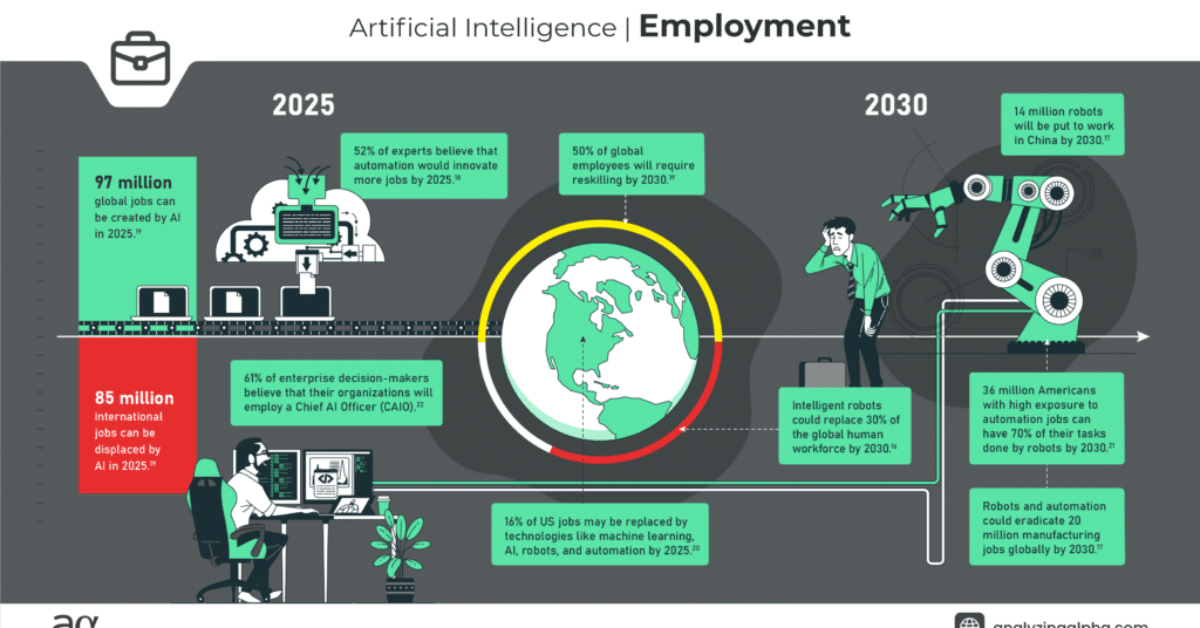
AI and job layoffs have surged into public discourse as reports reveal that AI can perform up to 12% of US jobs. However, despite the rapid advancement in AI job automation, widespread layoffs have not materialized yet. This article explores the complex relationship between AI’s capabilities and its surprising impact on the US workforce automation landscape.
AI and job layoffs: Understanding the paradox
Despite AI’s growing ability to automate tasks, AI and job layoffs have not correspondingly spiked. Experts attribute this to several factors: companies are investing in AI tools to support workforce efficiency rather than replacing large numbers of employees immediately; there’s a strong emphasis on job skills upskilling for AI; and AI is reshaping jobs rather than eliminating them completely. The gradual workforce reshaping through AI allows firms to maintain employee morale while strategically integrating automation.
The adoption of AI has targeted specific job sectors, predominantly entry-level job automation roles where repetitive tasks can be automated without extensive layoffs. This selective automation, paired with a dynamic labor market, explains the slowed layoff trends in 2025 despite AI’s capabilities.
Why the slow rate of layoffs despite AI automation?
While AI can theoretically automate 12% of jobs, companies face challenges in immediate layoffs. These hurdles include legal regulations, ethical concerns, the complexity of full automation, and workforce resistance. Additionally, the economic environment pushes firms to balance automation costs with the benefits of human experience and adaptability. This dual reliance on AI and humans marks a transformative phase in the AI-driven job market changes seen across industries.
Moreover, many organizations view AI as a tool to enhance productivity rather than replace workers outright. The trend emphasizes AI workforce transition where employees move to higher-skilled roles supported by AI, preserving jobs during the shift.
How will AI shape future layoff trends?
Looking ahead, the intersection of AI and the job market points towards continued evolution rather than sudden displacement. As AI technology matures, the focus will likely shift to enhancing workforce capabilities and leveraging smart automation to open new job categories.
To understand the broader impact, exploring global AI developments is essential, such as UK AI advances in naval forces and automation, which reflect the strategic integration of AI in critical sectors.
For more detailed analysis, check authoritative insights in the India Today report on AI impacts and the McKinsey research on AI and the future of US jobs.
Adapting to this shift involves continuous job skills upskilling for AI and embracing AI as a partner, not just a replacement.